The report
How many joined and kept going, ache before and after, the share whose ache eased by 2 points or more, energy and sleep. Each department of 5 or more people gets its own line.
Break the Stillness Trap at Work
A 4-week desk-health programme for offices, led by Coach Abdul Rehman. Your people get short, guided movement breaks on their own phones, picked by what hurts. You get a report at the end, with totals only, never names.
A 45-minute talk for your staff: why sitting hurts, and what 3 minutes a day can do.
Your team follows the plan in the app, with your company’s own code and a short note from Coach each week.
A report for HR with totals only, never names, and a results talk with your team.
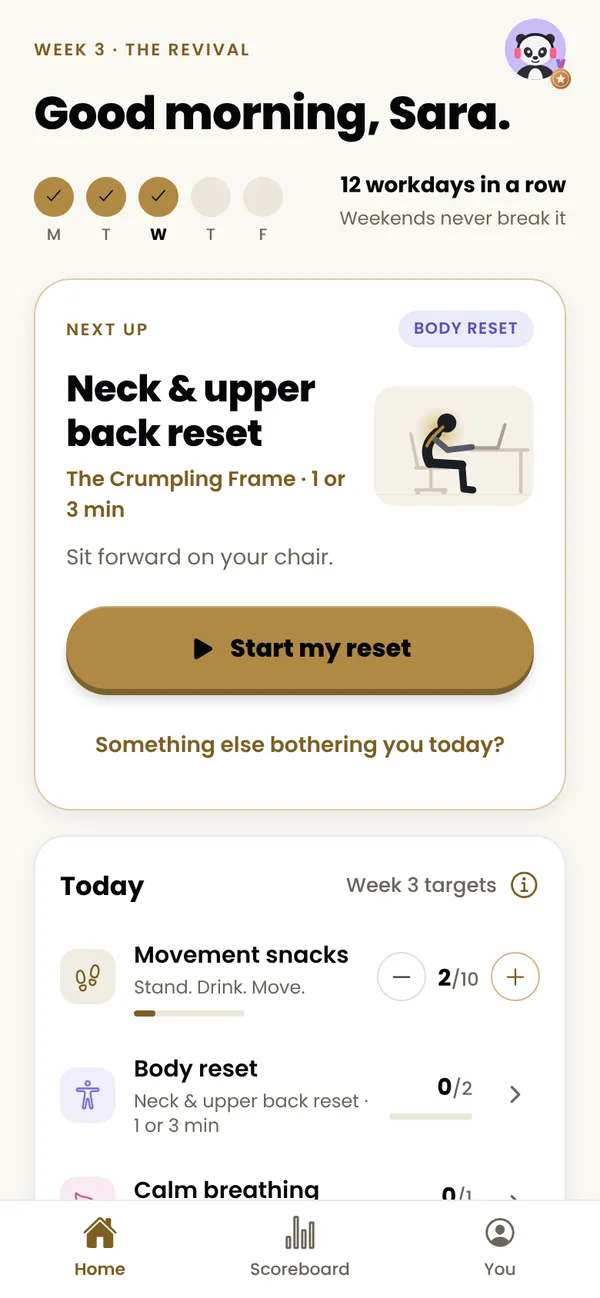
A short report you can hand to your board, a launch that takes HR about 15 minutes, and Coach with your team from start to finish.
How many joined and kept going, ache before and after, the share whose ache eased by 2 points or more, energy and sleep. Each department of 5 or more people gets its own line.
About 15 minutes of HR’s time: one email with your company’s code and one poster, both written for you. Then three short emails during the four weeks, also written for you.
The talk before week 1, a short note each week, and a results talk at the end, where the report is read with your team, not just sent.
“HR will see that the sales team moved more this week. They will never see who didn’t.”
That rule is what makes people press Done instead of deleting the app in week two. It is built into the app, the report and the agreement.
UK employers must plan screen work so it is broken up by breaks or changes of activity (DSE Regulations 1992, regulation 4), and the EU has the same rule (Directive 90/270/EEC, Article 7). The programme helps with the breaks and supports your DSE training and workstation checks. It doesn’t replace them.
In a field study of data-entry workers, four extra 5-minute breaks a day eased aches and eyestrain with no drop in output (Galinsky 2000).
Every move says when to stop. People with a new injury, recent surgery, a pregnancy or a heart condition are asked to see a doctor first. Moves that use a chair say to use a steady one that can’t roll. It is general guidance, not medical advice.
Every plan shows its studies, with links. Then your own four weeks show what changed in your office, in your people’s own answers.
The Desk-Body Workshop: one live session on Zoom or Teams that gives your team the resets in one go.
About 15 minutes to launch: one email and one poster, both written for you. Then three short emails during the four weeks, also written for you. Staff install the app and type your company’s code.
Reminders come only in work hours and go quiet right after people move, at lunch, and once the day’s breaks are done. A missed day is forgiven. Your report counts people active each week, not downloads.
Yes. Each department gets its own code, and your report shows every department of 5 or more people. Smaller departments are put together, so no one can be picked out. Departments are never ranked.
No. It installs like any app, on a personal or work phone, with no company sign-in and no access to other apps. A small tool can also post the reminders to a Teams or Slack channel.
Not yet. It is in testing now, and reaches the stores before the first programmes start. About the app
A fixed price for the four weeks, then a price per person if you keep going. It depends on how many people join, so ask for a quote on a 15-minute call.
Pick a start date on a 15-minute call, or send a message about your team.