You know that sitting all day is not great. But how often should you actually get up, and for how long? I read five recent studies so you don’t have to. Here is what they found, in plain words, and the one habit I take from them.
The habit
Every 30 minutes, move for 2 to 5.
An easy walk, or about 15 chair stands at your desk. Busy day? Every 60 minutes still helps.
What happened to people who took breaks
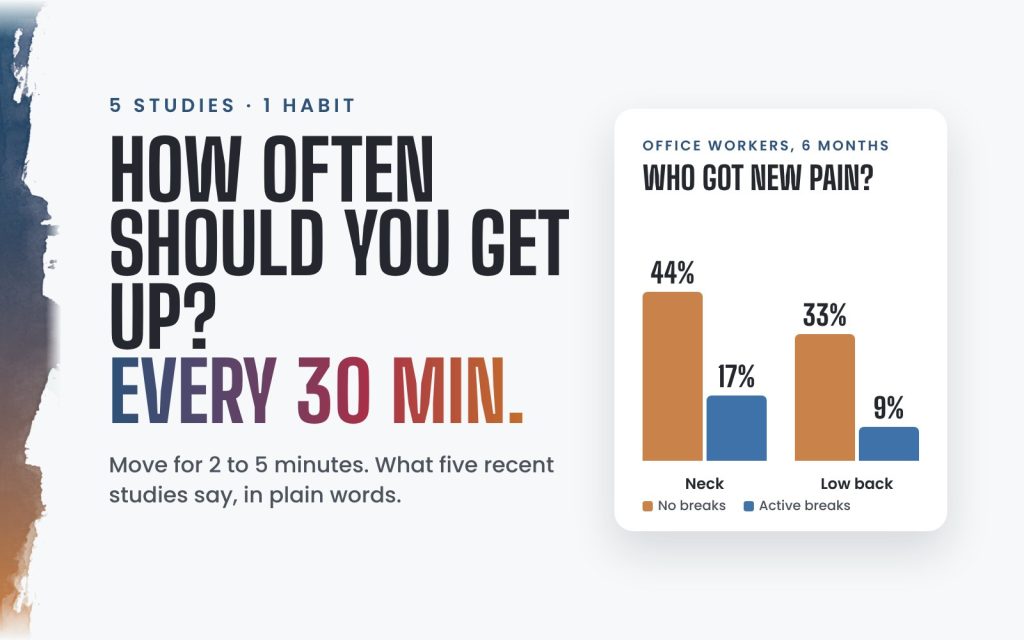
Office workers at risk, over 6 months
Who got new pain?
No breaks (placebo pad) Active breaks
The 5 studies, in plain words
1. Five minutes every 30 minutes was the sweet spot
Duran and colleagues, Columbia University, 2023
11 adults sat in a lab for 8 hours on five different days. On some days they walked on a treadmill for 1 or 5 minutes, every 30 or every 60 minutes. Only 5 minutes every 30 minutes lowered their blood sugar. Every schedule lowered blood pressure a little, by about 4 to 5 points at best.
The catch: Only 11 people, in a lab.
2. Chair stands work too
Gillen and colleagues, University of Toronto, 2021
14 young, healthy adults sat for 7.5 hours. Every 30 minutes they did either a 2-minute walk or 15 chair stands with calf raises. After lunch, their insulin (the hormone that clears sugar from the blood) rose much less: about 29% less with walks and 37% less with chair stands.
The catch: Young, healthy people, and nothing changed after breakfast.
3. Walking beats standing
Buffey and colleagues, Sports Medicine, 2022 (a review of 7 studies)
Across the studies, light walking breaks lowered blood sugar after meals more than standing breaks did. Standing helped a little. Walking helped more.
The catch: All short lab studies, and the results varied a lot.
4. Breaks and neck and back pain
Waongenngarm and colleagues, 2021
193 office workers at risk of neck and back pain were followed for 6 months. One group got a seat pad and an app that reminded them to take active breaks. New neck pain: 17% with breaks vs 44% without. New low-back pain: 9% vs 33%. That is the chart above.
The catch: Mostly women, and we don’t know exactly how many breaks each person took.
5. Breaks and how you feel
Diaz and colleagues, British Journal of Sports Medicine, 2026
About 19,000 people tried 5-minute walking breaks for two weeks. They felt less tired and in a better mood, and the more often they moved, the bigger the change. Breaks every 30 or 60 minutes made a real difference to tiredness. Work performance barely changed.
The catch: People reported how they felt themselves and chose their own schedule.
Do this today
- Set a reminder for every 30 minutes. The Break the Stillness Trap app does this for you, or use any timer.
- When it goes off, move for 2 to 5 minutes: walk to get water, take the stairs, or take a call standing up.
- Can’t leave your desk? Do 15 chair stands: stand up, sit down, slowly, using a steady chair that can’t roll.
- Busy day? Every 60 minutes still helps.
- These breaks add to your weekly exercise. They don’t replace it: the WHO recommends 150 to 300 minutes of moderate activity a week.
Watch: chair stands at your desk, Level 1 for beginners and Level 2 if you want it harder.
Be safe: if you have heart disease, high blood pressure that isn’t under control, joint or balance problems, or you take medicine that lowers blood sugar, check with your doctor first. This is general guidance, not medical advice.
Sources
- Duran AT et al. Breaking up prolonged sitting to improve cardiometabolic risk: dose–response analysis of a randomized crossover trial. Med Sci Sports Exerc 2023;55(5):847–855. doi:10.1249/MSS.0000000000003109
- Gillen JB et al. J Appl Physiol 2021;130(1):104–113. doi:10.1152/japplphysiol.00796.2020
- Buffey AJ et al. Systematic review and meta-analysis. Sports Med 2022. doi:10.1007/s40279-022-01649-4
- Waongenngarm P et al. Cluster-randomized trial in office workers. Scand J Work Environ Health 2021;47(4):306–317. doi:10.5271/sjweh.3949
- Diaz KM et al. NPR “Body Electric” challenge study. Br J Sports Med 2026. doi:10.1136/bjsports-2025-111221